
Honda ESG Report 2026: When 99% of the Problem Leaves the Factory Gate

There is a number in the Honda ESG Report 2026 that quietly dismantles the way most people think about corporate carbon footprints. Honda's direct operational emissions — everything that happens inside its factories, offices and owned vehicles, the Scope 1 emissions that companies most often talk about — accounted for just 0.4% of its total climate impact in the fiscal year ended 31 March 2026. Add the electricity it buys, its Scope 2 emissions, and the combined figure is still only 0.8%. The remaining 99.2% happened somewhere else: in Honda's supply chain, and above all in the hands of the people driving its cars and riding its motorcycles. As the report states plainly, “The majority of our greenhouse gas emissions are attributable to CO2 emissions generated during the use phase of our products.”
That single sentence is the story of the 2026 report, and it is the reason a company can decarbonise its own operations impressively while its overall footprint keeps rising. Honda's total greenhouse gas emissions — Scopes 1, 2 (market-based) and 3 combined — rose from 212.51 million tonnes of CO2 equivalent in the year ended March 2024, to 226.95 million tonnes a year later, and to 232.38 million tonnes in the year ended March 2026. Roughly 20 million tonnes of additional annual emissions in two years, from a company that is, by most operational measures, moving in the right direction. Understanding how both things can be true at once is the most useful lesson any business can take from this disclosure.
The anatomy of a 232-million-tonne footprint
Honda breaks its total footprint into the standard three scopes, and the proportions are stark. Of the 232.38 million tonnes reported for the year ended March 2026, Scope 1 direct emissions were 0.892 million tonnes and Scope 2 market-based emissions were 1.04 million tonnes — together 1.93 million tonnes, or that 0.8% sliver. Scope 3, the emissions across Honda's upstream and downstream value chain, came to 230.45 million tonnes. Within Scope 3, one category towers over everything else. Category 11, the “use of sold products,” reached 176.74 million tonnes — 76.1% of Honda's entire carbon footprint on its own. This is the tailpipe: the petrol burned and the grid electricity consumed by every Honda vehicle, motorcycle and power product sold and then used out in the world, counted across its expected lifetime.
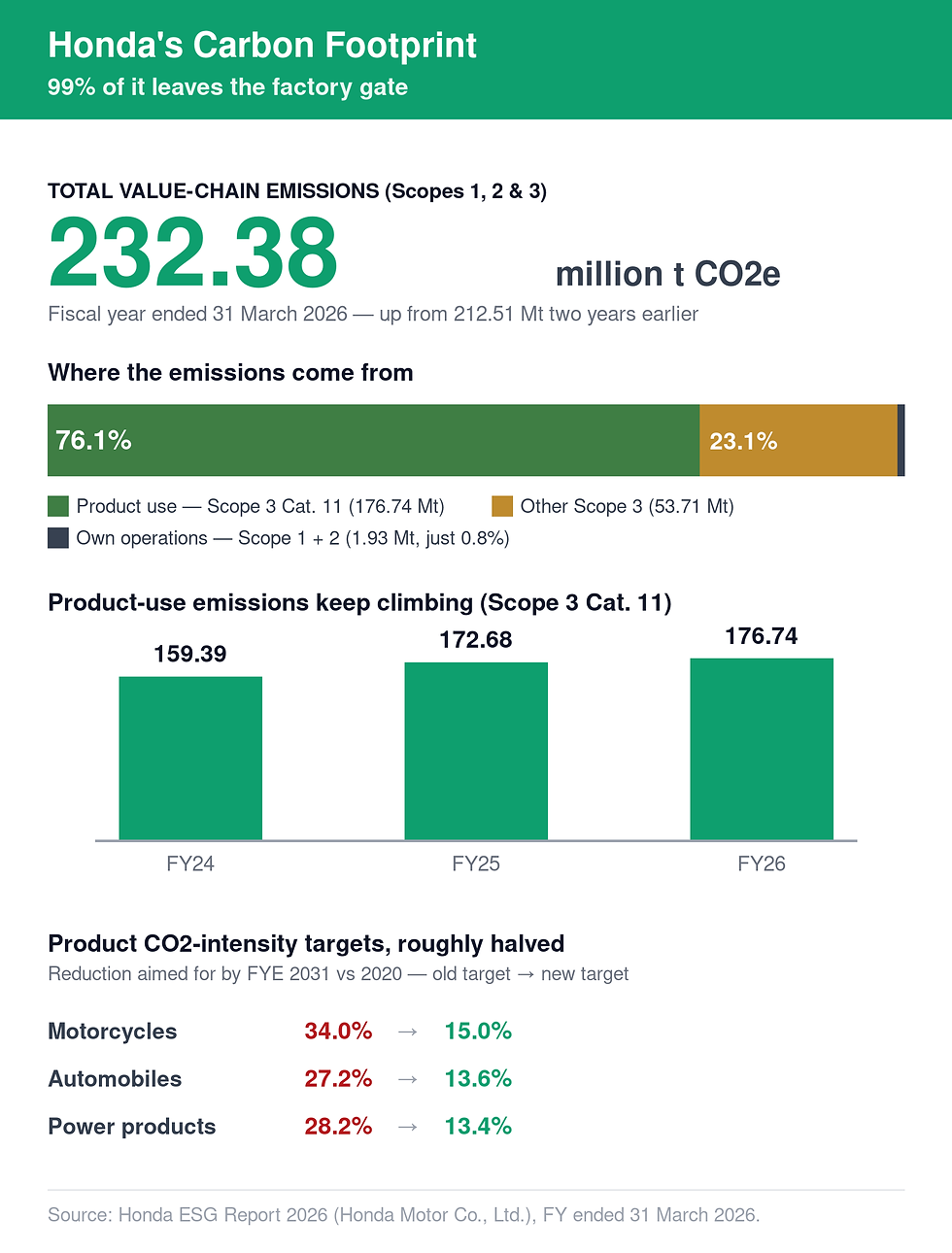
The rest of Scope 3, at 23.1% of the total, is far from trivial in absolute terms even if it is dwarfed by product use. Category 1, purchased goods and services — the steel, aluminium, plastics, electronics and rubber that go into a vehicle — accounted for 41.13 million tonnes. Category 12, the end-of-life treatment of sold products, was 4.32 million tonnes. Category 4, upstream transportation and distribution, rose sharply to 4.03 million tonnes from 2.55 million tonnes two years earlier, and Category 2, capital goods, climbed to 2.17 million tonnes. These are the embedded and logistical emissions of making and moving things at Honda's scale. But they are a rounding note beside Category 11.
What makes the 2026 figures more credible than many corporate disclosures is that Honda widened the net rather than narrowing it. The report notes that its coverage of Category 11 emissions was extended from approximately 90% of global sales volume to nearly 100%, and that it switched its calculation methodology to the International Energy Agency's Mobility Model. In other words, part of the reason the numbers look large is that Honda chose to measure more of them, more rigorously. This is worth pausing on, because the easiest way for any company to shrink its Scope 3 total is simply to measure less of it. Honda did the opposite, and its reported footprint grew as a result. Honda also reminds readers of its history here: it says it became the world's first mobility company to disclose not only Scope 1 and 2 emissions but its full upstream and downstream Scope 3, back in August 2012 for the year ended March 2012.
The operational success story — and why it barely moves the needle
None of this is to say Honda's operational progress is hollow. On its own terms it is genuinely strong. Honda has set an interim target to cut absolute CO2 from its corporate activities — Scope 1 plus Scope 2 — by 46% by the year ending March 2031, against a 2020 baseline. By the year ended March 2026 it had already reduced those emissions by 51.3%, having moved from a 37.7% reduction two years earlier to 47.5% and then past its own 2031 goal five years early. The corporate-activity CO2 figure fell to 2.45 million tonnes. Honda brought its first carbon-neutral factory online in the final quarter of the year ended March 2026 — the Saitama Factory automobile plant — and states its intention to expand carbon neutrality to all its automobile production sites worldwide. It has run an internal carbon price of 15,000 yen per tonne of CO2 at its Japanese sites since 2023 to steer investment decisions. It was named to CDP's climate A-List for 2025, its third consecutive year at the top rating.
All of that effort, all of that capital, addresses the 0.8%. This is the uncomfortable arithmetic at the centre of the report, and it is not unique to Honda — it is the structural reality of any company whose products consume energy after they are sold. You can make your factories carbon-neutral, run them on renewable electricity, and price your own carbon internally, and you will have moved less than one percent of your total footprint. The 99% walks out of the gate with the customer. Honda's own operational renewable electricity illustrates the point about scale: its data tables report 1,950 gigawatt-hours of renewable electricity utilised in the year ended March 2026, with a further 134 gigawatt-hours self-consumed, backed by instruments such as a virtual power purchase agreement with Rusutsu Wind. Meaningful, and the right direction — but a lever on the small share of the problem.
The only decarbonisation lever that reaches the 76.1% is the product itself. To cut Category 11, Honda has to change what leaves its showrooms: fewer combustion engines, more electric vehicles and hybrids, cleaner fuels, and a grid that is itself decarbonising so that the electricity powering those EVs is low-carbon. This is why product-use emissions and the electrification debate are the same conversation seen from two angles, and it is where the 2026 report becomes genuinely newsworthy.
The targets Honda quietly halved
Here the report contains an admission that many readers will miss in the density of the tables. Honda revised its product CO2 intensity targets — the reductions it aims to achieve per vehicle in the use phase by the year ending March 2031, against a 2020 baseline — sharply downward. For motorcycles, the target was cut from 34.0% to 15.0%. For automobiles, from 27.2% to 13.6%. For power products, from 28.2% to 13.4%. In each case the ambition was reduced to roughly half of what it had been. In the report's own words, “the targets were revised from 34.0% to 15.0% for the motorcycle business, from 27.2% to 13.6% for the automobile business, and from 28.2% to 13.4% for the power products business. These revisions reflect our reassessment of our powertrain portfolio and product launch plans in response to changes in market conditions and developments in trade policies.”
The progress against even these softened targets is modest so far. By the year ended March 2026, Honda reports it had reduced motorcycle product CO2 intensity by 1.6% against the 2020 baseline, against the new 15.0% goal; automobiles had reached roughly 12.5%, close to their revised 13.6% target; and power products stood at 2.8% against 13.4%. The automobile business is tracking near its target, but the motorcycle and power-product segments have a long way to travel even against the lowered bar.
Honda goes further still. It signals that it will stop using the sales ratio of electrified products as a management indicator altogether. As the report puts it, the company “determined... to shift from using the sale of electrified products as a measurement toward contributing to the reduction of greenhouse gas emissions across society as a whole, which is a more fundamental approach,” and it plans to set specific target levels for the year ending March 2036 based on the reduction rate of total greenhouse gas emissions across the entire life cycle, rather than the electrified-sales ratio. There is a defensible logic to this: an electrified-sales percentage tells you how many EVs and hybrids a company sells, not how much carbon those products actually save once the grid, the manufacturing footprint and the vehicle's full life are accounted for. A life-cycle emissions metric is, in principle, more honest and harder to game. But the timing — a shift away from a concrete, trackable EV-sales commitment, arriving in the same breath as halved intensity targets and citing “trade policies” and “market conditions” — will invite the reading that Honda is softening its transition and reaching for a metric that is years away from having teeth.
Why measuring the hard 99% is the point
Underneath the target revisions, the most important thing Honda did in 2026 was keep counting honestly. It methodically maps its product carbon footprint by breaking roughly 20,000 parts into about 50 constituent material types, and it has adopted the Japanese automotive industry's carbon-footprint guideline and updated emission factors to do so. It ran a full life-cycle comparison of the combustion-engine N-ONE against the electric N-ONE e:. It pursues smaller, unglamorous wins in the parts of Scope 3 it can influence directly — a modal shift of electric-vehicle power-unit components from truck to rail, for instance, cut roughly 700 tonnes of CO2 a year, about 75% for that flow. These are the actions of a company treating its whole value chain as its responsibility rather than drawing the boundary at the factory fence.
That distinction — where a company chooses to draw the line around its own accountability — is what this report ultimately illuminates, and it matters far beyond Honda.
Why it matters
The most valuable thing in Honda's 2026 disclosure is not a success; it is an honest inconvenience. A company reduced the emissions it fully controls by more than half, beat a target five years early, opened its first carbon-neutral factory — and its total footprint still went up, because 99.2% of that footprint was never inside the factory to begin with. For any business trying to understand its own climate responsibility, this is the lesson worth internalising: the emissions you own on paper and the emissions you are actually responsible for are usually two very different numbers, and the gap between them is Scope 3.
It is genuinely tempting for a company to report the 0.8% loudly and let the 99% stay quiet. Operational emissions are measurable, controllable and improvable; a renewable-energy contract or a carbon-neutral plant makes for a clean headline. Scope 3 is the opposite — sprawling, partly outside your direct control, dependent on suppliers you don't own and customers you can't follow home, and, when measured properly, embarrassingly large. The path of least resistance is to under-count it, scope it narrowly, or footnote it. Honda's report is useful precisely because it refuses that comfort. It widened its product-use measurement toward 100% coverage, adopted a more rigorous model, and published a number that grew as a result. That takes a kind of discipline that a smaller reduction in a well-chosen boundary would have spared it.
The accountability point cuts both ways, though, and this is where scrutiny belongs. Transparency about a rising number is worth little if it becomes a substitute for bending the curve. Honda now has to actually cut the 76.1% — and the same report shows it softening the very targets that govern that share, halving its product intensity goals and stepping back from a concrete electrified-sales commitment in favour of a life-cycle metric that only acquires firm target levels around 2036. Honest measurement and weakened ambition can coexist, and in this report they do. The right response is not to celebrate the disclosure or dismiss the pullback, but to hold both: Honda deserves credit for owning the full scale of its value-chain emissions, and it deserves pressure to treat that ownership as an obligation to reduce, not merely to report.
For every other company reading their own footprint, the takeaway is simpler and more demanding than most sustainability communications admit. Ask where your 99% is. If almost all of your climate impact sits in your supply chain or in the use of what you sell, then a decarbonised head office is a start and not an achievement, and the credibility of your entire climate story rests on whether you are willing to measure — and then move — the part that is hardest to control. Honda has done the measuring. The next report is where we find out whether it will do the moving.
Figures in this article are drawn from the Honda ESG Report 2026 (Honda Motor Co., Ltd.), covering the fiscal year ended 31 March 2026. Emissions data cover Honda Motor Co., Ltd. and its consolidated subsidiaries.


Comments