

South Africa's Green Finance Taxonomy: What It Is and How to Use It
South Africa’s Green Finance Taxonomy is the country’s official list of activities that can be called “green” when you raise money, invest or report. It is voluntary, it currently has detailed criteria only for climate change mitigation and adaptation, and it is being tested by the financial regulator before any wider rules are set. If your organisation wants capital, reports on ESG, or oversees public spending, you need to know how the test works now so that your data is ready when expectations harden. We built this guide to take you from the definition to a first practical assessment.
Key Takeaways
The taxonomy is a voluntary classification of assets, projects and sectors that qualify as green, launched by National Treasury on 1 April 2022.
An activity is aligned only if it makes a substantial contribution to an environmental objective, does no significant harm to the others, and meets minimum social safeguards. The result is simply aligned or not aligned.
Six environmental objectives are defined, but technical criteria exist only for climate change mitigation and adaptation, across 44 activities in 7 sectors.
The financial regulator’s pilot gathered information until 30 January 2026, with results expected in the 2026/27 financial year, so disclosure expectations may follow.
Organisations that start collecting activity-level data on turnover, capital expenditure and operating expenditure now will be best placed to use it.
What the taxonomy is and why it exists
A green finance taxonomy is a shared dictionary. Without one, a bank, a pension fund and a municipality can each call a project “sustainable” and mean different things. South Africa’s version is, in National Treasury’s words, a catalogue of the minimum set of assets, projects, activities and sectors eligible to be defined as green, in line with international best practice and national priorities.
Treasury’s launch statement sets out what it is meant to achieve:
clarity and certainty when choosing green investments;
more large-scale capital for climate-friendly projects;
lower financial risk and lower costs of labelling and issuing green instruments;
better support for regulatory oversight.
The design borrows from the European Union model, which groups activities under environmental objectives and adds “do no significant harm” and social safeguard tests, but it reflects South African priorities. The taxonomy is also described as a living document, to be updated and expanded through a governance process overseen by an intergovernmental working group of regulators, including the Prudential Authority and the Financial Sector Conduct Authority (FSCA).
Who it is for
The first edition names policy agencies, regulators, financial market participants and asset owners as the expected users. In practice that reaches further than banks:
Businesses that want to show lenders or investors that a plant, fleet or building upgrade is green.
Organisations preparing ESG reports that need a defined way to say how much of their activity is aligned.
Government bodies and municipalities that tag climate spending or issue green or use-of-proceeds instruments.
Investors and lenders that need a consistent screen for what they finance.
Eligibility is judged by economic sector, asset and/or project, which means a company can be partly aligned. A manufacturer, for instance, might have one aligned solar installation and a large conventional product line. You assess and report on the part that qualifies, not the whole company.
What is covered: objectives, sectors and activities
The first edition defines six environmental objectives:
Climate change mitigation
Climate change adaptation
Sustainable use of water and marine resources
Sustainable resource use and circularity
Pollution prevention
Ecosystem protection and restoration
The limit to remember is that technical screening criteria were developed only for mitigation and adaptation. The other four are to be filled in by later editions. So a waste-reduction or water project can still be recognised under the objectives as a concept, but there are not yet detailed thresholds against which to certify it. That matters to local communities and organisations focused on waste, who should treat the taxonomy as a framework still being completed for their theme.
On scale, Treasury’s own comparison with the EU reports that the South African taxonomy covers 44 economic activities across 7 sectors, against 88 activities in 9 sectors in the EU’s climate delegated act (as of September 2022). The same comparison notes that it excludes fossil fuel-related activities and electricity generation from natural gas and nuclear.
The three tests an activity must pass
For an activity to be “taxonomy-aligned” it needs all of the following:
Substantial contribution. It meaningfully advances at least one of the six objectives, measured against the technical screening criteria where they exist.
Do no significant harm (DNSH). It must not damage the other objectives. A hydropower scheme that cuts carbon but degrades a river ecosystem is the classic case.
Minimum social safeguards (MSS). The company behind the activity must meet baseline standards on matters such as labour rights and community impact.
The outcome is binary. There is no partial credit and no “light green” band.
Why DNSH and social safeguards need most of your effort
These two tests are where organisations spend the most time. The FSCA’s June 2026 newsletter calls the criteria conceptually sound but operationally challenging without precise guidance, and adds that any future disclosure requirements tied to the taxonomy should be proportionate and user-friendly. A technical paper by GreenCape and the Climate Policy Initiative for National Treasury reached a similar view: international alignment is high, but usability suffers when firms have to demonstrate DNSH and MSS.
In practice, build the evidence file before you need it: environmental permits, impact assessments, supplier and labour policies, grievance records and community engagement logs. Social safeguards also touch how a company is seen by workers and neighbours, so the same documents support reputation risk mitigation when a project comes under scrutiny.
Applying the taxonomy: the seven-step assessment
The first edition lays out a seven-step route. Read together with the way the taxonomy is described in the official text, it works like this:
Step | What you do | Where it commonly goes wrong |
|---|---|---|
1. Familiarise | Read the principles and definitions | Assuming it works like a general ESG rating |
2. Identify objectives | Decide which objective or objectives the activity serves | Choosing a water or waste objective that has no criteria yet |
3. Check inclusion | Confirm the activity appears in the taxonomy | Describing the activity loosely so it does not match a listed one |
4. Technical criteria | Test against the screening criteria | Missing data on performance thresholds |
5. DNSH and MSS | Show no significant harm and safeguards compliance | Evidence scattered across departments |
6. Conclude | Decide aligned or not aligned | Rounding up a borderline case |
7. Disclose | Publish the result | Reporting a single total instead of a breakdown |
On disclosure, the first edition encourages breaking financial flows down by turnover or revenue, capital expenditure and, where relevant, operating expenditure. Capex is often the most informative figure, because it shows where a company is putting money towards a green transition.
A worked example
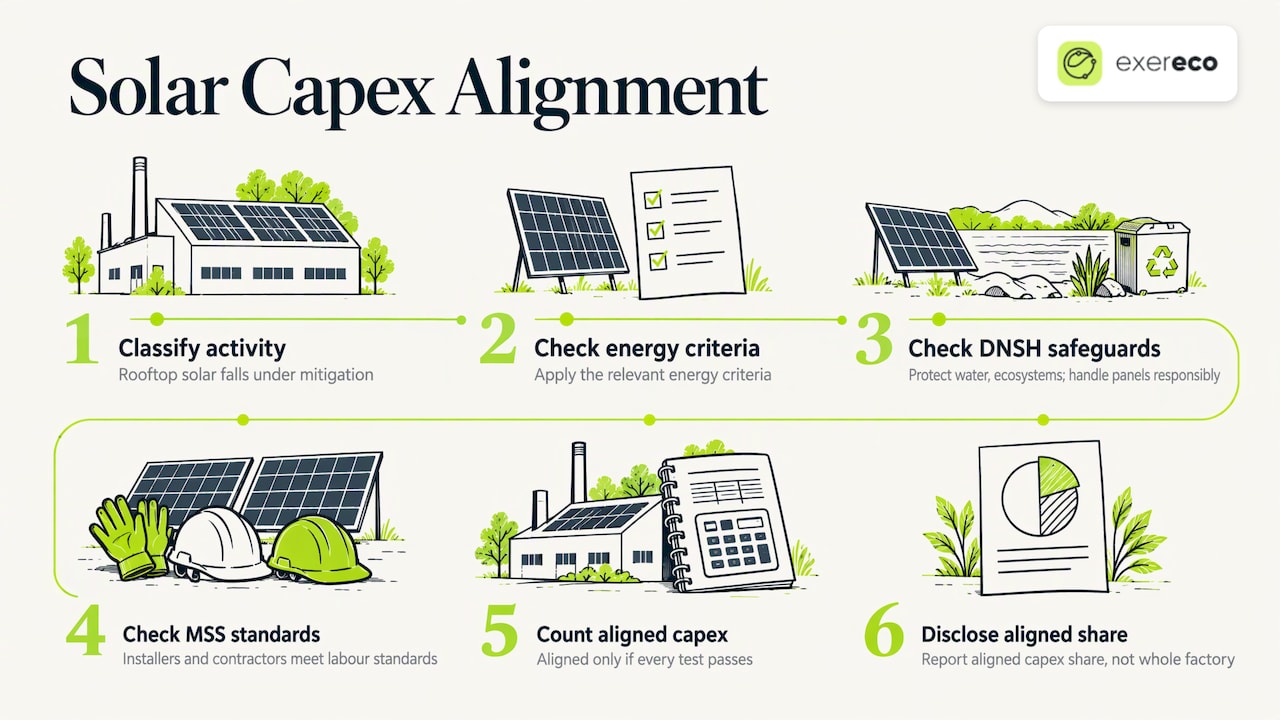
Imagine a food processor installing rooftop solar at a factory. The activity falls under climate change mitigation, so you would check it against the relevant energy criteria. For DNSH you would show, for example, that the installation does not harm water or ecosystems and that panels will be handled responsibly at end of life. For MSS you would show that installers and contractors meet labour standards. If every test passes, the solar capex counts as aligned; the rest of the factory’s capex does not. Your disclosure then states the aligned share of capex, not a claim that the whole company is green.
The Sustainable Finance Initiative’s training material adds a useful caution: the taxonomy sets a common language but does not replace ESG management, due diligence or fiduciary duty. It can be applied to use-of-proceeds instruments, general investment decisions and an organisation’s own performance reporting.
Where it stands now
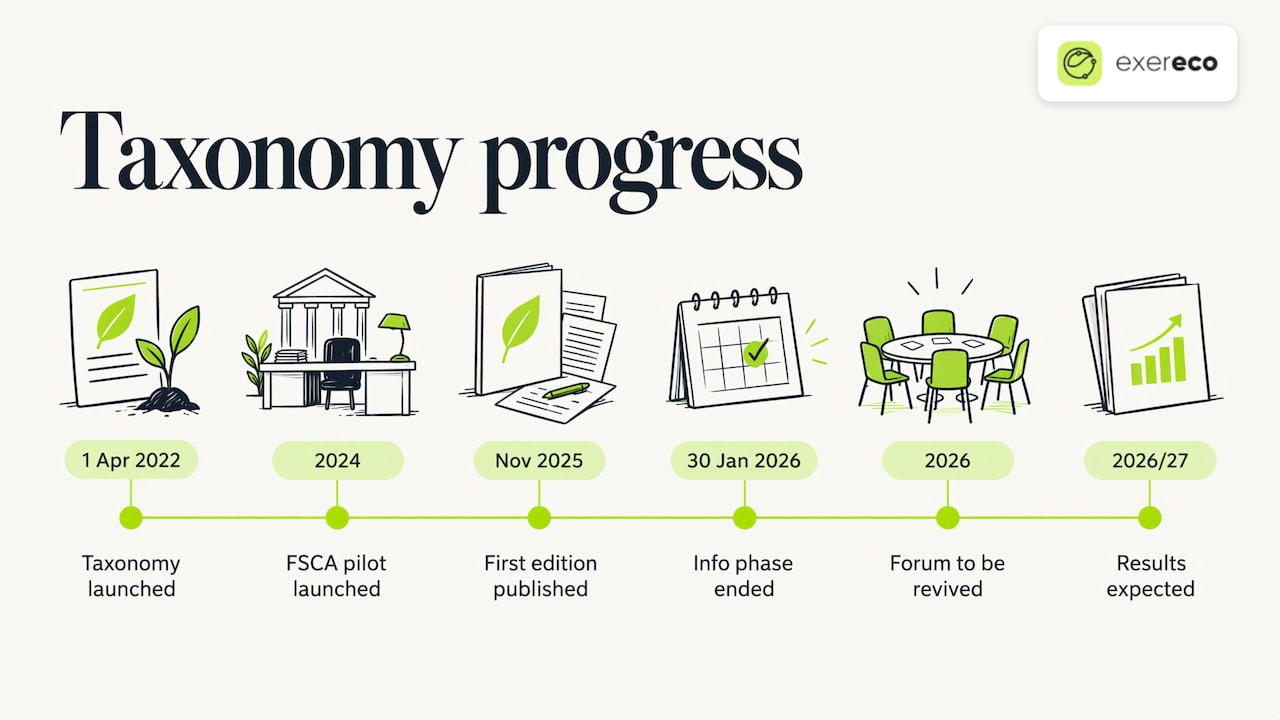
The taxonomy was launched on 1 April 2022 and remains voluntary. The Minister of Finance’s office told Parliament in 2023 that it is a voluntary market tool whose main purpose is market clarity.
The most recent movement comes from the FSCA, which launched a pilot in 2024 with banks, asset managers and pension funds using a learn-by-doing approach. According to the FSCA’s Sustainable Finance Update Report 2026, the information-gathering phase ended on 30 January 2026, comprehensive results are expected during the 2026/27 financial year, and the Climate Risk Forum is to be revived in 2026. Because these results will inform refinement of the taxonomy, check the FSCA and National Treasury websites for the latest publications rather than relying on any fixed timetable.
The November 2025 progress report from the Sustainable Banking and Finance Network also records the first edition as published, with tools and templates for project assessment and due diligence among the support available.
Voluntary does not mean irrelevant
Researchers have asked whether a voluntary approach is enough. A 2023 policy brief from the German Institute of Development and Sustainability found that a year after launch the taxonomy had hardly been applied, because assessments need data from many market agents and little is available when only a few disclose. It recommended that regulators issue usage guidance and consider mandatory reporting rules.
The reasonable reading for your organisation is that early preparation pays. If guidance or disclosure rules follow the pilot, those who already hold activity-level data will adapt fastest, and those seeking international funding will find a common language useful. The Climate Policy Initiative’s South African Climate Finance Landscape notes that international flows supplied an annual average of ZAR 73.7 billion, or 39.1%, of climate finance in 2022 to 2023. Foreign capital providers are used to taxonomies, so a clear classification helps projects speak to them.
The same report points out that the taxonomy omits transition finance, which narrows its relevance for high-emitting sectors such as mining, energy and transport. If you work in one of those sectors, expect the conversation about transition activities to continue, and keep your emissions and decarbonisation data in a form you can reuse under whichever framework emerges.
A practical starting plan
Map your activities. List the assets, projects and business lines, with turnover, capex and opex for each.
Match them to the taxonomy. Mark which ones plausibly sit within the 44 listed activities.
Collect DNSH and MSS evidence. Assign an owner for each document type so the file is ready when a lender asks.
Decide your disclosure format. Use the turnover, capex and opex breakdown so your figures are comparable.
Review as editions change. New objectives and criteria will change what can qualify.
If your team is new to the vocabulary, our Introduction to ESG course covers the fundamentals, and our ESG Disclosure course goes into how results are reported. For the wider picture on instruments and rules across the continent, read our guide to sustainable finance in Africa. To see how a lender presents its numbers, our analysis of Absa’s R53.5 billion sustainable finance year shows what accountability looks like in a published report.
How Exereco supports taxonomy readiness
Exereco offers ESG reporting software, advisory and compliance support, training courses and sustainability news with a focus on Europe and Africa, all in one place. That makes it possible to follow regulatory developments such as the FSCA pilot, train your team on disclosure, and structure your reporting without stitching together separate providers.

If you want to follow how taxonomy and disclosure rules develop, our news and updates page tracks sustainability developments across Europe and Africa, and you can reach the team through Exereco to discuss reporting or advisory support.
FAQ
Is South Africa’s Green Finance Taxonomy mandatory?
No. National Treasury describes it as a voluntary market tool, and the Minister of Finance’s office confirmed this to Parliament in 2023. The FSCA pilot is gathering evidence that may shape future disclosure requirements, so it is sensible to prepare data now.
Which environmental objectives have detailed criteria?
Only climate change mitigation and climate change adaptation. The first edition defines six objectives, but the criteria for water and marine resources, circularity, pollution prevention and ecosystem protection are to be developed in later editions.
What does “taxonomy-aligned” mean?
It means an activity makes a substantial contribution to at least one environmental objective, does no significant harm to the others, and meets minimum social safeguards. The assessment gives a yes or no answer, with no partial scores.
Does the taxonomy cover fossil fuels or gas?
No. Treasury’s comparison with the EU taxonomy notes that the South African version does not include fossil fuel-related activities or electricity generation from natural gas and nuclear. Critics, including the Climate Policy Initiative, also note that transition finance is not covered.
How do I start using it in my organisation?
Start by mapping each activity with its turnover, capex and opex, then compare it with the listed activities and gather evidence for the harm and social safeguard tests. Follow the seven-step process in the first edition and disclose the result as a breakdown.
Sources
All sources are linked where their facts appear above.
Recommended


Comments