

Renewable Energy in Africa: Latest Developments and What They Mean
Africa’s renewable energy story is moving from pledges to hardware. Sub-Saharan capacity additions doubled in 2025, solar imports are surging, and wind, geothermal and storage projects are reaching financial close. The harder question for a business, a municipality or a regulator is what each headline means for energy access, supply-chain risk and ESG commitments. At Exereco we cover sustainability across Europe and Africa, so this guide gathers the developments worth following, the numbers behind them and the constraints that decide whether projects get built.
Key Takeaways
Renewable capacity additions in sub-Saharan Africa doubled in 2025 to around 12 GW, led by solar in South Africa.
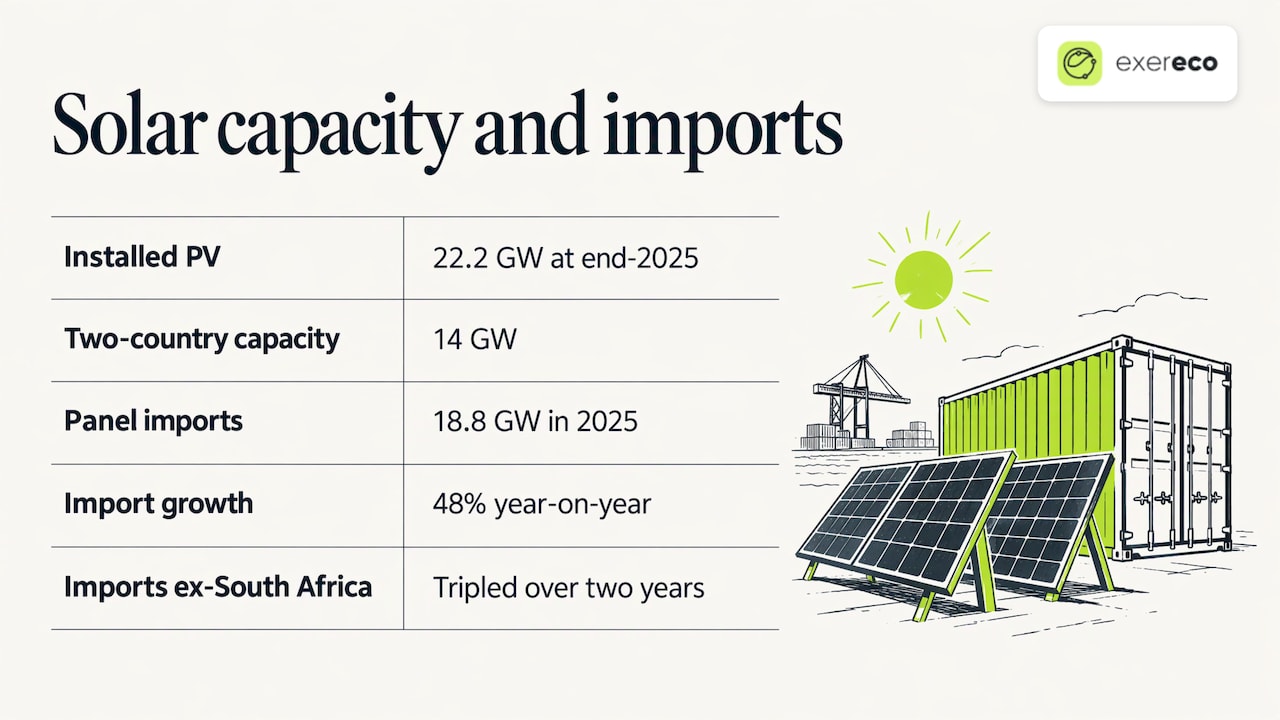
Solar growth is concentrated: of 22.2 GW installed at the end of 2025, 14 GW sat in just two countries.
Finance, not resource, is the main brake: Africa attracts less than 3% of global energy spending despite about 20% of the world’s population.
Grids matter as much as generation, so transmission, storage and procurement rules decide how much clean power reaches customers.
Forecasts point up: the IEA expects additions across North and sub-Saharan Africa to almost triple in 2026 to 2031 against the previous six years.
Where the new capacity is being built
The International Energy Agency (IEA), the intergovernmental energy body, reports that renewable additions in sub-Saharan Africa doubled in 2025 to around 12 GW. Solar PV, hydropower and wind all contributed. South Africa led, installing more than 3 GW of solar PV in a single year for the first time.
Solar is the engine. A September 2026 report on Africa’s solar sector estimates installed solar PV at 22.2 GW at the end of 2025, with 14 GW in two countries. The same report says Africa imported about 18.8 GW of solar panels in 2025, 48% more than in 2024, and that imports excluding South Africa tripled over two years. Panels are arriving faster than most national statistics can track, which suggests small commercial and rooftop systems are growing well beyond the utility-scale projects that make headlines.
For readers who want the global picture first, our overview and outlook of solar energy sets the African numbers against worldwide trends. Our Zambia report on a 945 MW solar surge shows a country where capacity growth is now testing the grid.
Projects that show the direction of travel
A handful of projects, each backed by development finance, illustrate the mix of technologies now moving.
Country | Project | Reported scale | Source |
|---|---|---|---|
Ethiopia | Aysha wind farm, described as the country’s first wind independent power producer | 300 MW, African Development Bank (AfDB) approval of up to USD 110 million, total cost estimated at USD 508 million | |
Egypt | Nagaa Hammadi solar with battery storage | 1 GW solar, 100 MW/200 MWh storage, estimated USD 593.6 million, 25-year power-purchase agreement | |
Kenya | Menengai geothermal steam field | Steam field prepared for 144.5 MW of generation for 25 years, 49 wells drilled toward a 50-well goal | |
Uganda | National solar target | 5 GW of solar PV by 2030 and 28 GW by 2040 |
The spread matters. Wind in Ethiopia, geothermal in Kenya and solar-plus-storage in Egypt show that the continent is not betting on one technology. Geothermal in particular offers round-the-clock output, which is why we followed it closely in KenGen’s geothermal push in Kenya. For the wider policy context, see Kenya’s path from green power to a carbon-free economy.
North Africa is opening up too. Our report on Libya opening the door to solar, wind and a power link with Europe is a good example of how African generation and European markets are becoming connected.
Egypt’s Nagaa Hammadi: why storage and grid come with the panels
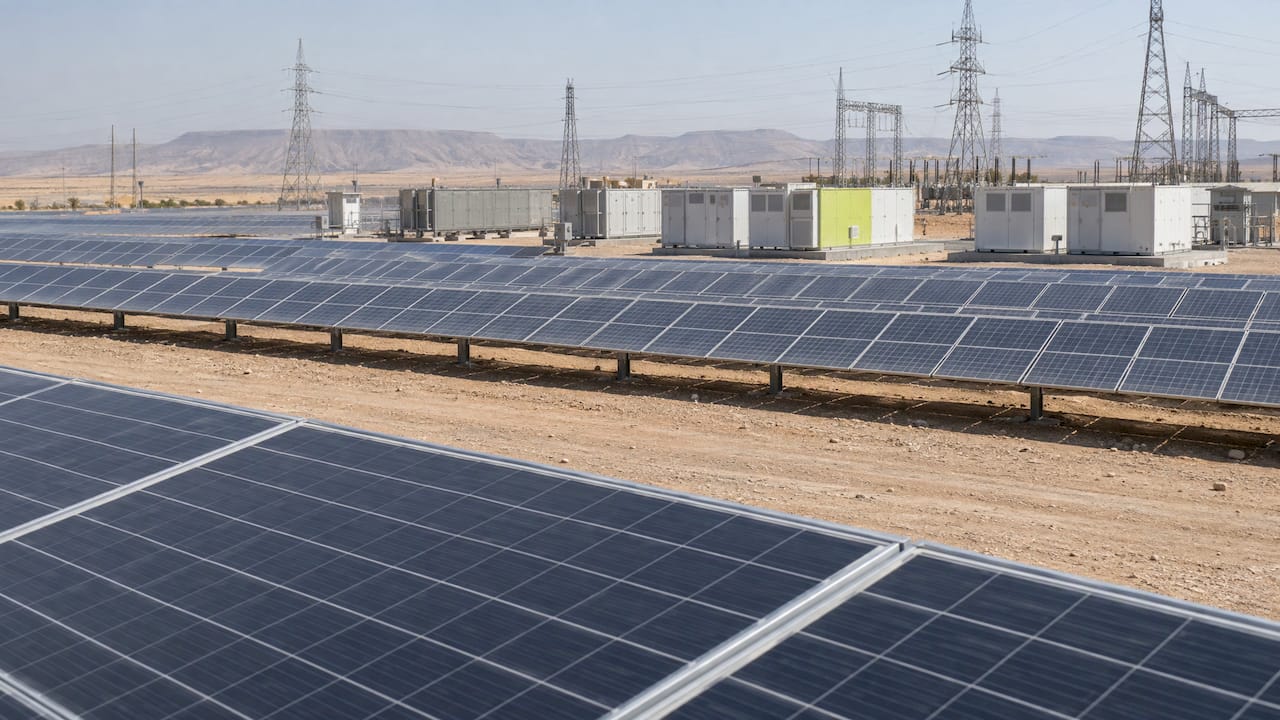
The Nagaa Hammadi project is a useful case because it shows what a modern large solar plant actually requires. The panels are only part of it. The AfDB reports that the project needs a new 12 km transmission line and supports Egypt’s Energy Transition Agenda 2035 target of 42% renewables. The 200 MWh of battery storage lets some daytime output be shifted into the evening peak.
The lesson applies at every scale: equipment has to be matched to real demand. Oversizing wastes capital, and undersizing leaves the benefit unused. The same discipline appears in building electrification planning that avoids oversized equipment, where sizing systems to actual loads protects budgets. For a company installing rooftop solar or a battery, the question is the same one the Egyptian project answers at utility scale: how much to generate, how much to store and how it connects.
Storage is also becoming cheaper to justify. The Solarising Africa report finds that the weighted-average cost of utility-scale solar electricity in Africa fell 67%, from USD 225/MWh in 2015 to USD 74/MWh in 2024. It estimates that storing half of daytime output gives dispatchable solar at about USD 76/MWh.
Why money, not sunshine, is the constraint
Africa has some of the world’s best solar, wind and geothermal resources. The limit is capital. The IEA’s analysis of clean energy investment in Africa finds that the continent attracts less than 3% of global energy spending while holding around 20% of the world’s population, and that energy investment has fallen 34% from its 2014 peak. It cites a shortage of bankable projects, high capital costs, debt distress and the credit risk of state utilities that buy the power. Capital costs for clean-energy projects can be two to three times those in advanced economies.
Solar shows the gap clearly. Africa received about USD 9 billion, or 2%, of the USD 521 billion invested in solar worldwide in 2024, according to the Solarising Africa report.
The IEA’s scenario for meeting development goals says annual energy investment must more than double by 2030 to almost USD 240 billion, with roughly three-quarters going to clean energy. Its work on electricity access calls for scaling financing to USD 15 billion a year for capacity, grids and decentralised solutions.
Who is paying
Public finance is a large part of the picture. The Africa-EU Energy Partnership reports that European Union institutions and member states committed EUR 20.67 billion to SDG7-compliant African projects over 2014 to 2023, the largest public source after multilateral institutions. SDG 7 is the UN goal on affordable and clean energy. Transmission and distribution took 28% of those European commitments, a sign that grids are now treated as a priority alongside generation.
Private investment has been uneven. IRENA, the International Renewable Energy Agency, finds that more than 90% of the nearly USD 60 billion invested in African renewables excluding large hydropower during 2000 to 2020 was committed in 2010 to 2020, and was concentrated in a handful of countries. The same review finds that structured procurement, including feed-in tariffs and auctions supported by development-finance credit enhancements, helped drive stronger investment in the 2010s.
If you are weighing green bonds, concessional loans or blended finance for a project, our guide to sustainable finance in Africa: instruments, rules and routes explains the main options.
Grids and phasing
Generation without wires does not deliver power. Botswana’s national energy compact says renewable generation should be phased according to grid-integration needs, transmission infrastructure and progress on regional offtakes. That is why a headline megawatt figure and the electricity actually delivered can differ for years.
What it means for businesses, communities and governments
Businesses
For companies operating in or sourcing from Africa, falling solar costs and rising panel imports make on-site generation and power-purchase agreements more realistic. Renewable electricity also feeds directly into Scope 2 emissions reporting, the emissions from purchased energy that most ESG frameworks ask for. Tracking which grids are getting cleaner, and where supply is unreliable, helps you decide where to invest and how to report credibly.
Local communities
Access is the first benefit. The IEA estimates that around USD 22 billion a year is needed from 2023 to 2030 to connect African homes and businesses to electricity, and USD 4 billion a year for clean cooking. Botswana’s compact shows how those numbers look at country level: electricity access of 76.6% and 33.9% of households still reliant on traditional biomass for cooking in 2024 and 2025. Cleaner cooking and reliable power also reduce the burning of waste and wood that harms local air quality, which links energy to community waste-reduction goals.
Governments
Public bodies are judged on delivery. The projects above show a pattern: clear national targets, a compact or procurement framework, development-bank backing and a plan for the grid. Where those four line up, capital follows. Where they do not, pipelines stall.
What is coming next
The outlook is strongly upward. The IEA’s 6 November 2026 renewables outlook forecasts that additions across the Middle East and North Africa and sub-Saharan Africa together will almost triple in 2026 to 2031 compared with the previous six-year period.
Specific pipelines are taking shape:
Botswana aims to raise renewables’ share of its energy mix from about 7 to 8% to 50% by 2030, while addressing transmission and distribution.
Uganda schedules resource-assessment drilling at Katwe, Buranga and Kibiro for 2026 to 2027, a first geothermal tender of about 50 MW in 2029 and 300 MW reaching financial close in 2030.
Italy and UNDP announced an initial EUR 10 million for clean-energy pilot and demonstration projects, particularly in Africa, with the first competitive calls expected in the first quarter of 2027.
IRENA’s 2026 geothermal discussions also point to what scaling firm clean power needs: faster permitting, early-stage demonstration to reduce risk and frameworks that value firm power.
How to turn the headlines into decisions
A practical routine for an organisation tracking this sector:
Pick the countries that touch your operations or supply chain. Capacity is concentrated, so a continent-wide average tells you little.
Separate announcements from financing milestones. Approval, financial close, construction and grid connection are different stages, and the gap between them can be years.
Check the grid. A plant waiting for a transmission line is not yet delivering clean power to anyone.
Map it to your reporting. Note which developments change your emissions factors, energy access commitments or SDG targets. Our page on SDG 7: clean energy is a useful starting point for that mapping.
Revisit quarterly. Procurement rounds, tenders and funding calls recur through the year.
Our news and press section follows these developments across Europe and Africa as they happen.
From reading the news to acting on it
Exereco brings sustainability news, ESG advisory, ESG reporting software, training courses and community networking events together in one place, with a focus on European and African audiences. If renewable energy developments are changing your emissions reporting, your compliance obligations or your climate strategy, our team can help you turn them into practice. Explore our climate action work or start from the Exereco homepage.

Our advisory, software, training and events are built for organisations seeking better ESG compliance and more sustainable practices.
FAQ
How much renewable capacity did Africa add recently?
The IEA reports that sub-Saharan Africa’s renewable capacity additions doubled in 2025 to around 12 GW. South Africa led, installing more than 3 GW of solar PV in a single year for the first time. Figures are revised as data arrives, so check the IEA’s latest review.
Which African countries lead on solar?
Installed solar is highly concentrated: of about 22.2 GW at the end of 2025, 14 GW was in two countries, according to the September 2026 Solarising Africa report. Imports excluding South Africa tripled over two years, so more countries are catching up.
What is holding back renewable projects in Africa?
The IEA points to a shortage of bankable projects, high capital costs, debt distress and the credit risk of state utilities. Grid capacity is another factor, which is why transmission and storage feature in major projects such as Egypt’s Nagaa Hammadi plant.
How does renewable energy growth affect ESG reporting?
It changes the emissions factors behind purchased-electricity (Scope 2) reporting and supports energy access and climate targets under the SDGs. Organisations with African operations or suppliers should track country-level grid developments rather than relying on continental averages.
What comes next for African renewables?
The IEA expects additions across North and sub-Saharan Africa to almost triple in 2026 to 2031 compared with the previous six years. National pipelines, such as Uganda’s 5 GW solar target for 2030 and Botswana’s 50% renewables goal, show where that growth is planned.
Recommended


Comments